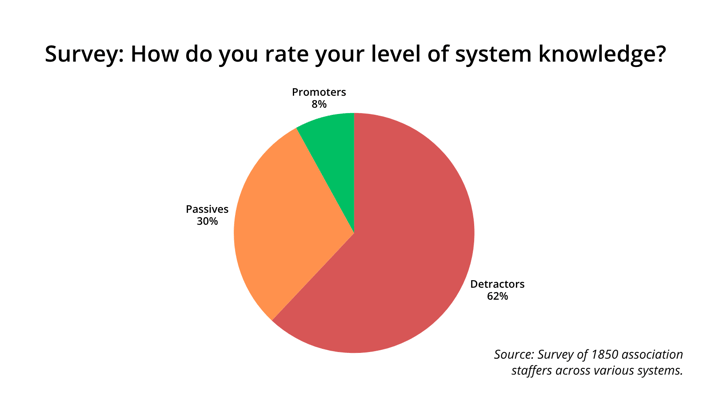

Ever feel like your staff is just trying to “get through the day” with the tools they have? In a survey of over 1850 association staff, 62% said they don’t feel confident using the systems they rely on every day. That’s a big problem, but a huge opportunity.
Why staff education matters at membership organizations
We surveyed over 1850 association staff, and 62% tell us they are not confident in their system knowledge.

So, what happens when staff are not confident in the systems used to do their jobs?
- They try things until something works, not necessarily the right way, then they repeat that going forward.
- They are inefficient in their jobs.
- They tend to rely on other staff members and overload them.
- They do things inconsistently.

In our organizational maturity assessment with hundreds of association executives, we look at 7 best practice areas. When we look at the bottom 10% of respondents, we see that system knowledge ranks lowest in the 7 best practice areas. This shows that struggling organizations assess themselves to have the worst system knowledge.
When we compare that to the top 10% of organizations, we see that system knowledge is high. We have found in our experience that the best practice areas have direct correlation to other areas. For example, if you have poor system knowledge and lack defined processes, it’s almost inevitable that you don't trust your data.
This lines up with research finding that companies are 17% more productive and 21% more profitable when they have effective staff education.
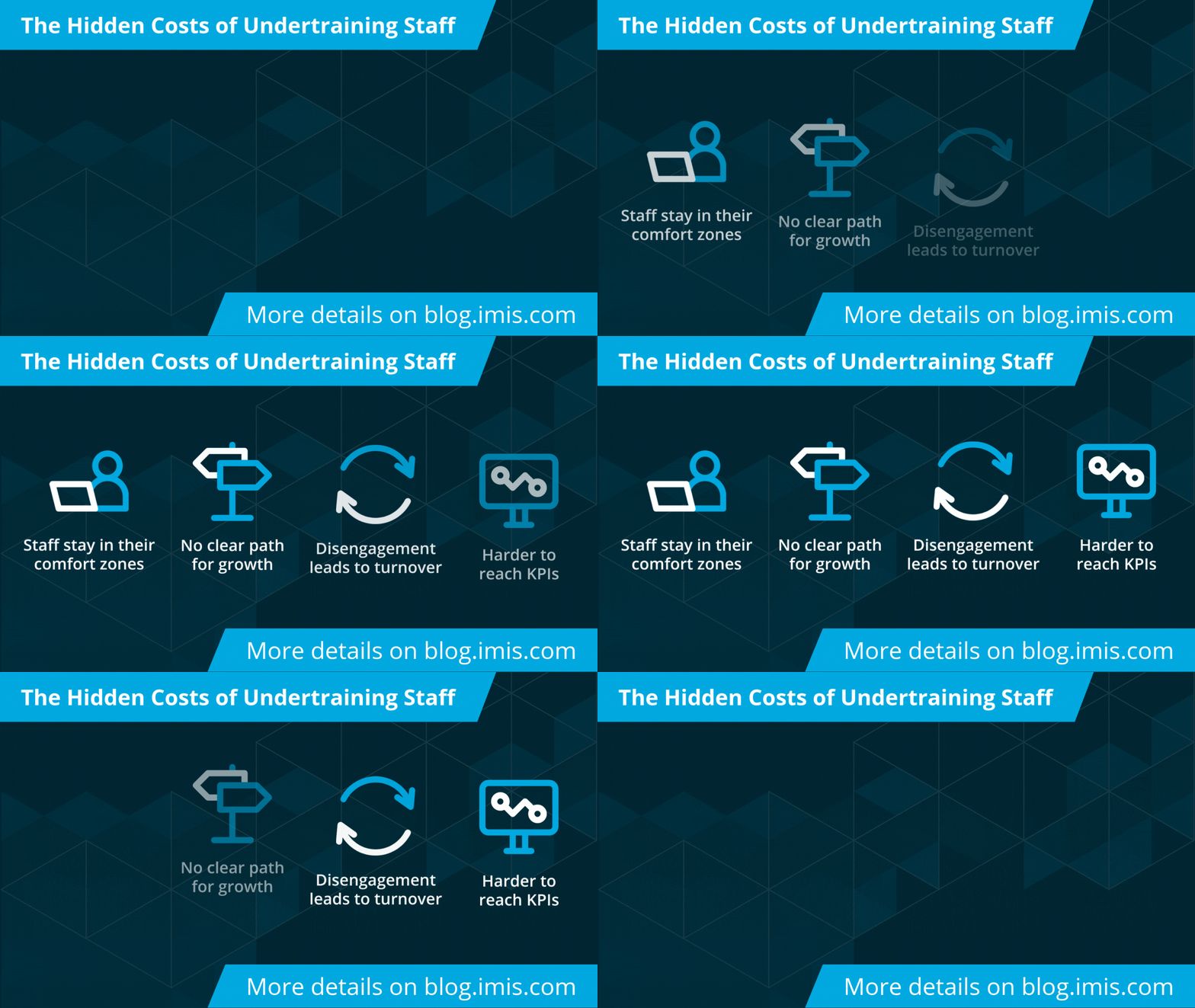
Read more in our article, The Hidden Costs of Undertraining Your Staff.
How to create a supportive learning environment at your membership organization
Show the "why"
Staff need to know why learning is valuable. What's their motivation?
Tie learning directly to member value and organizational goals. Don’t treat it like a nice-to-have. When you connect learning to your mission, people see training time as an investment, not a distraction.
Provide time to learn
Staff need to be taught how to use your membership management software, and not just during onboarding. If learning isn’t scheduled, it may not stick. Block recurring time for webinars, brown-bag sessions, or vendor classes. Maybe it only needs to be 30 minutes each week!
Assign mentors
Mentorship transforms passive learning into practical skill-building. Start with onboarding (assign every new hire a mentor) and extend it beyond the first month. ASAE offers guidance on starting mentoring programs and shows the ROI for mentors, mentees, and the organization.
Team projects
Create a team (2 or more staff) to work together on a project. This reduces isolation, enhances accountability, and makes it more fun!
Try small, time-boxed, cross-functional projects. Like membership + finance, or education + marketing. This way, colleagues see how all their work connects.
AuSAE has encouraged peer-to-peer learning as an everyday habit. People are far more likely to ask a colleague than search the web when they get stuck. Build spaces (channels, huddles, quick demos) where that sharing is normal.
Have a central place to keep track of what they've learned
Keep it all in one place:
If a staff member finds a slightly faster way to complete a billing process, don't let that tip get lost forever in a Slack message! Even quick tips are worth adding to documentation. Make sure your staff know exactly how to update documentation, otherwise they may shy away.
From the iMIS Blog: 4 Reasons Your Association Shouldn't Ignore Documentation
Celebrate their learning!
What have they achieved? What have they managed to implement based on their learning? Even if it’s a seemingly small thing, make sure to encourage learning and growth.
Shout out course completions, badges, and certifications in all-hands, newsletters, or team channels. That will make team members feel valued, and may give a push to others to start a new course.
Quick starter kit (what to try in the next month or two)
- Pick one cadence. Block 60 minutes every other week for team learning. Ideally, you'll learn together so you can ask questions and collaborate. But if this isn't feasible, each person can work on their own course/content. Encourage people to send messages after the time block with quick tips they learned, or something they'd like to try out.
- Create a “Start Here” page. Maybe give it three sections: Watch (recordings), Read (SOPs/one-pagers), Try (checklists/templates). Or you can organize based on the department or topic.
- Recognize wins. Add a “Learning Shoutouts” slide to your next all-hands. Include CPD/CAE-aligned activities so staff see how growth advances careers.
Does your organization use iMIS? Take advantage of these learning tools:
ASI Training offers several opportunities to support your team’s learning needs. Get your team up and running with onboarding training, develop your skills with a certification, and continue to support your staff with available professional development opportunities.
Online Learning via the ASI Learning Hub. Access courses or full training programs with personalized learning portals and managers assigned to learners to track progress.
Coaching in small groups or one-on-one to help answer those burning questions.
Certification programs to learn and recognize developing skills across all products.
Bootcamps for learners to take in-person training and complete full certifications in one or two days.
Learning Pathways for role-based training and recommendations for learning programs.
All ASI Training events
More resources: