Request a Demo

Contact Sales

Get Pricing

Member Retention

Member Retention: 8 Impactful Strategies to Reduce Churn

Master member retention with proven strategies for associations. Learn how to calculate retention, win back lapsed members, and use tech to build loyalty.


Key Takeaways

  • Prioritizing member retention over aggressive acquisition offers a higher return on investment, lowers marketing costs, and provides long-term financial stability for your association.
  • Members often join for content but stay for community. Fostering member connections and recognizing individuals’ achievements make your organization an indispensable professional home rather than a simple subscription.
  • Accidental member attrition is a major threat, but automating renewals and offering generous grace periods can eliminate the administrative hurdles that often lead to lapses.
  • Have a plan ready to win back your lapsed members, including a survey asking why they’re leaving and a “we miss you” email campaign highlighting what they’ve missed later on.
  • Leveraging an Engagement Management System (EMS) like iMIS allows organizations to move from reactive record-keeping to predictive health scoring, helping to identify and intervene with at-risk members before they cancel.

Winning a new member is a victory, but sustainable growth relies on strong member retention. If you want to focus more on retaining members, you're not alone. In our annual membership benchmark report, organizations overwhelmingly cited increasing engagement and retention as their top goal for the year.

Without a solid strategy to keep your existing members engaged, even the best recruitment campaigns will eventually fail to outpace churn. To build the stability you need to grow your association, you need a thoughtful member retention plan.

That's exactly what this guide provides! We'll explore the essentials of reducing member attrition, from calculating key metrics to implementing proven tactics that inspire long-term loyalty. Here's what we'll cover:

As you explore our recommended strategies, remember that your technology is the foundation of your member retention strategy. The right system lets you scale your efforts and keep your team energized. Keep reading to discover smart strategies and see how iMIS can help bring them to life.

Unlock the tools you need to build a strong, engaged community of members. Watch a free tour of iMIS.

Member Retention FAQ

What is member retention?

Member retention is the percentage of members who remain with your organization over a specific period of time, typically measured annually.

This metric acts as a report card for your member experience, quantifying your ability to deliver enough value to secure a renewal. Unlike acquisition, which focuses on capturing new audiences, retention is the continuous process of nurturing existing relationships to ensure your community doesn't slip away to competitors.

How do you calculate your member retention rate?

Use this formula to get an accurate picture of how well you are convincing members to stick around:

Member Retention Rate = [ ( Number of Members At End - New Members ) / Number of Members At Start ] x 100

So, let's say you started the year with 1,150 members. You ended with 1,325. During that time, you recruited 360 new members. Here is how the math works:

  1. Subtract new members: 1,325 - 360 = 965 (These are the members you kept).
  2. Divide by start count: 965 / 1,150 = 0.839.
  3. Multiply by 100: 0.839 x 100 = 83.9%.

Don't want to do the math manually? Plug your numbers into our interactive calculator below to see your current member retention rate instantly:

What is a good membership retention rate?

A “good” member retention rate depends on the type of organization you run, but industry benchmarking shows that a healthy association should aim for an overall retention rate of 80% or higher. Associations with overall renewal rates below 80% and first-year member renewal rates below 60% are much more likely to report membership losses over a five-year period.

What is membership attrition?

Membership attrition is the reduction in an organization’s membership due to both voluntary and involuntary lapses, often calculated year over year.

While the term is sometimes used interchangeably with churn, churn typically refers specifically to voluntary membership cancellations (e.g., a member deciding to leave because they no longer see value). Attrition encompasses all member losses, including involuntary ones like a member retiring, changing industries, or failing to update an expired credit card.

To calculate your member attrition rate, you can use this formula:

Attrition Rate = (Number of Members Who Left / Average Total Number of Members) x 100

(For example, if 50 members left and your average total membership for the year was 500, your attrition rate would be 10%.)

Don't let your data bog you down. Learn how to tame the chaos in your database. Download your free playbook.

Why Member Retention Matters for Your Association

While attracting new faces is exciting, the true mark of a sustainable association is the community you've already built. Shifting your focus from aggressive acquisition to strategic retention offers a significantly higher return on investment and insulates your organization against market downturns.

Here are the primary benefits of prioritizing a retention-first strategy:

The benefits of having a high member retention rate, also written below.

  • Lower Marketing Costs: It's more cost-effective to retain current members than to invest in finding new ones. Think about the time it takes to market to, nurture, and onboard a new prospect versus the lower effort required to engage someone who already knows your value.
  • Financial Stability: High retention rates create a predictable, recurring revenue stream, allowing you to budget for future programs and innovations with confidence.
  • Higher Lifetime Value (LTV): The longer a member stays, the more revenue they generate over time through dues, event registrations, and continuing education purchases.
  • Organic Referrals: Satisfied, long-term members tend to tell their friends. They'll recruit their peers and reduce your need for expensive outreach campaigns.
  • Stronger Leadership Pipeline: Long-term members are the ones who step up to volunteer, mentor, and lead. High retention ensures a steady flow of experienced, committed individuals ready to define your organization's future.

Overall, prioritizing your association's member retention will lead to a thriving community. By investing in the members you already have, you create the stability needed to fuel growth.

8 Impactful Member Retention Strategies

Calculating your retention rate gives you the baseline, but moving that number in the right direction requires deliberate action. The eight high-impact association strategies below explore how to build long-term loyalty by personalizing the onboarding experience, fostering peer connections, and leveraging regular surveys to understand exactly which benefits drive renewals. This way, you can systematically eliminate friction, anticipate why members might leave, and create a thriving community.

Create A Meaningful Onboarding Experience.

First impressions set the trajectory for a member's entire relationship with your association. 78% of organizations reported an average or better renewal rate for first-year members compared to last year, likely because they had a strategic plan for integrating them into their community.

To do the same, move beyond a single confirmation email and extend a warm welcome. Try implementing a 90-day onboarding journey that gets them familiar with their benefits, your association, and your entire member community. This sequence should guide new members toward specific behaviors that deepen their investment, such as: 

  • Completing their profile within your online community.
  • Joining a committee or a special interest group.
  • Taking an online course or downloading a resource.
  • Connecting with a volunteer “buddy” or ambassador to show them the ropes.

Additionally, you might offer a new member orientation webinar or a virtual coffee chat each month to introduce new members to staff and fellow newcomers. These personal connections help break the ice and make them feel like part of a community.

Build A Strong Sense of Community Within Your Association.

Members often join for the content but stay for the community. A member who builds personal relationships within your organization is less likely to churn since they don't want to lose those connections. In fact, MGI’s Membership Marketing Benchmarking Report indicates that 53% of association executives believe members most often join associations to network. Meet those expectations to boost your member retention rate.

To build a tight-knit community, create spaces where members can talk to one another, not just to you. According to that same report cited above, these are some of the top community-building strategies that associations use:

  • Private online communities to discuss industry trends and find other nearby members through a membership directory.
  • Special Interest Groups (SIGs) to connect members by specific niche or region.
  • Virtual or in-person networking events designed specifically for socializing, like happy hours and dinners.
  • Peer networking groups or circles that provide spaces for members to troubleshoot shared career challenges and brainstorm solutions.
  • Mentorship programs that pair industry veterans with eager newcomers.

When you build these bridges, you stop being just another subscription and start being a professional home. It's easy to cancel a service, but it's much harder to walk away from a group of friends and mentors.

Recognize Member Achievements.

When an organization validates a member's expertise or loyalty, it creates a psychological barrier to exit. Leaving your association would mean leaving behind the status and reputation they have built within your community.

Launch a recognition program that celebrates contributions large and small. Some ideas include:

Different member appreciation ideas to use as part of your member retention strategies, also written below

  • A “Member of the Month” feature in your newsletter, highlighting recent career wins or contributions to the field
  • Digital badges for activities like volunteering, completing courses, or serving on committees
  • Social media shoutouts that publicly tag and thank members for their insights
  • Personalized notes from leadership to celebrate renewals and tenure milestones
  • Peer-nominated awards (such as The Community Connector who goes above and beyond to introduce people to one another) presented at events, giving members a platform to celebrate each other's success

When you celebrate your members' success, they become personally invested in yours, directly impacting your association's member retention rate. This validation turns them into natural ambassadors who are eager to bring others into the mix.

Send Regular Member Satisfaction Surveys.

Waiting until a member cancels to ask for feedback is simply too late. As part of your membership retention strategy, plan to routinely check on members’ satisfaction throughout their entire journey. Routine surveys show members you value their input and provide the data you need to course-correct before minor frustrations turn into member attrition. 

To get the most actionable insights, set up automated triggers in your membership software to send surveys at these opportune times:

  • The 60- and 90-Day Mark: Ask new members about their onboarding experience, if they’ve successfully logged into the community, and which resources they need help finding.
  • After Events: Send a quick poll after a webinar, annual conference, or networking event to measure the value of your programming.
  • Mid-Year: Around the six-month mark of their membership cycle, ask a few broad questions about overall satisfaction. This helps you identify and rescue at-risk members before their renewal invoice is generated.
  • After a Major Interaction: Trigger a survey following a support ticket resolution, a completed certification, or the end of a volunteer committee term to gauge their experience.

Spacing out your surveys helps you gather insights without overwhelming your members. Just make sure you act on the data you receive, proving to your community that their voices shape the association.

Personalize Value Based on Career Stage.

A student member needs different resources than a C-Suite executive. Sending the same generic newsletter to both results in low engagement because it forces the member to hunt for relevant content.

Instead, segment your database to deliver personalized value to each member. Use the data you already have (job title, years in industry, location, etc.) to send targeted content. Here's an example of what that might look like:

  • For Early Career Members: Send a Young Professionals Digest focused on certification study groups, resume reviews, and mentorship opportunities.
  • For Senior Leaders: Send an Executive Leadership Brief featuring high-level industry trends, policy updates, and exclusive roundtable invites.

Modern systems like iMIS make this approach scalable, helping to retain members more efficiently. You can segment members based on criteria like job title or tenure. This allows you to deliver personalized communication, ensuring every member feels like your content was written specifically for them.

Automate Renewals and Offer Generous Grace Periods.

Sometimes, losing a member has nothing to do with value and everything to do with renewal friction. In fact, More than a quarter of association professionals say that members forgetting to renew is one of the top three contributors to attrition.

To avoid accidental member attrition, you need to take the administrative work off your members' plates. Don't rely on them to remember the renewal date. Instead, replace manual invoicing with automated renewals.

As a bonus, this frees up staff time. For example, the Life Sciences Trainers & Educators Network (LTEN) freed up 20+ monthly hours of accounting support by automating tasks like invoicing, application acknowledgments, and approval letters with iMIS.

Beyond automated renewals, consider setting up a generous grace period. Two-thirds of associations provide a grace period of one to three months after expiration. This gives busy professionals breathing room to correct an oversight without losing their benefits or tenure at your organization.

By treating a missed payment as an honest mistake rather than a cancellation, you increase your member retention by saving members who never intended to leave.

Know Which Benefits Are Driving Member Retention.

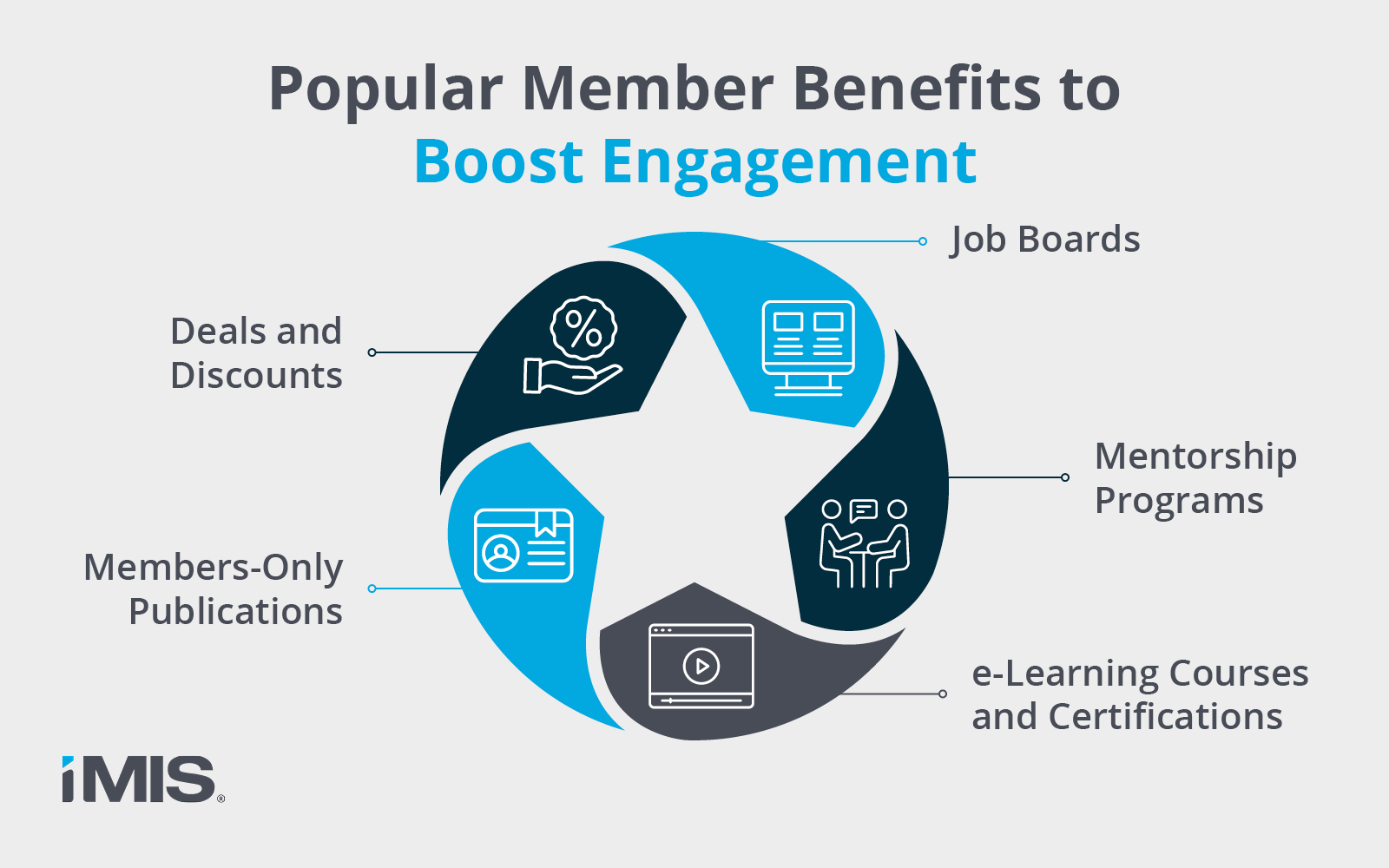
To optimize your member retention strategy, you need to know which offerings make your members stay. Some popular member benefits include:

Popular benefits to include in your member retention strategy.

  • Deals and discounts
  • Career centers and job boards
  • Mentorship programs
  • Continuing education courses and certifications
  • Publications and digital resources

While industry benchmarks are a great starting point, you ultimately need to know what matters most to your unique community. The surveys we previously mentioned are a great way to gather this information. Make it a habit to ask members to rank your offerings or to tell you which specific benefit is their primary reason for renewing.

Dive into your association software to track benefit participation. Which webinars have the highest attendance? Which resources are downloaded most often? Which certification courses have the highest completion rates?

By cross-referencing your survey feedback with real behavioral data, you can identify your most popular offerings. Just as importantly, this gives you the evidence you need to confidently sunset underused options. Cutting the dead weight lets you double down on the benefits that are actually driving member retention.

Understand Common Reasons Members Don’t Renew.

While it’s easy to assume members leave simply because they no longer want to be part of the organization, the reality is often much more nuanced. By tracking why members walk away, you can transition your member retention strategy from a guessing game into a data-driven plan.

In our annual Membership Performance Benchmark Report, we asked association professionals the primary reasons their lapsed members didn’t renew. They listed these reasons:

  1. Budgetary constraints
  2. Lack of engagement with the organization
  3. Perceived value of membership
  4. Forgot to renew
  5. Company closed or merged
  6. Too expensive
  7. Trial/Student memberships don’t convert

Understanding specific exit reasons dictates how you solve the problem. If a significant portion of your member attrition is due to people forgetting to renew, you’ll know to implement automated renewals and generous grace periods. If trial memberships aren't converting, you can create a transitional “young professional” dues tier. When you know why they leave, you can build the safety nets needed to make them stay.

Don’t miss out on the latest trends and strategies for member engagement. Download our free benchmark report.

Devising A Plan To Win Back Lapsed Members

When a member leaves, don't just delete them from your membership database. Instead, build a specific off-boarding track that leaves the door open for their return.

Start by implementing a two-step exit process. Before finalizing the cancellation, offer an option to pause or move to a cheaper tier. Often, a member doesn't want to leave entirely. They just need a temporary break or a lower price point.

If they do cancel, use it as a learning opportunity. Trigger an immediate, one-question survey that asks, “What is the primary reason you are leaving?” You can't fix a leak if you don't know where the hole is, and this feedback is vital for improving member retention for the rest of your base.

Finally, play the long game. Wait 3 to 6 months before launching a “We Miss You” email campaign designed to win them back. In this campaign, you'll want to:

  • Show them what they missed. Send a digest of recent wins, top-rated resources, or event photos to remind them of the value they left behind.
  • Remove the friction. Offer a limited-time “Amnesty Month” where you waive reinstatement fees and pre-fill their renewal form so they don't have to reapply from scratch.

Around 70% of association leaders report email as being the most effective way to win back lapsed members, but several also cite member-to-member outreach (46%) and board outreach (38%) as smart options. Think about what would work best for your member base!

Statistics about how to win back lapsed members and improve your association member retention.

By treating lapsed members as future prospects rather than lost causes, you ensure that the door to your community never truly locks shut. Plus, re-engaging lost members is often more time- and cost-effective than cold acquisition.

How Purpose-Built Technology Helps Predict and Prevent Member Attrition

The most dangerous form of churn is the kind you never see coming. Too often, organizations operate in a reactive mode, realizing a member is disengaged only after they have already cancelled. 

To flip this dynamic, you need to move from simple record-keeping to predictive health scoring using an Engagement Management System (EMS) like iMIS. By consolidating your data, an EMS allows you to monitor member behavior in real time, identifying at-risk members so you can intervene before it's too late.

A mockup of iMIS's member engagement reporting dashboard

Here's how a purpose-built system like iMIS enables you to boost member retention:

  • Use engagement scoring. Don't guess who's happy—measure it! iMIS allows you to define your own engagement criteria (like event attendance or committee service) and track scores for each individual. When a score drops, you'll know exactly who needs attention. Our association management glossary explains that engagement scoring is a way to easily identify passionate advocates and those at risk of lapsing.
  • Automate renewals. Remove the friction of manual payments. iMIS makes it easy for members to join and renew online with auto-renewal options, ensuring you never lose a member simply because they forgot to pay an invoice.
  • Personalize at scale. Generic emails and web content get ignored. With iMIS, you can use data-driven segmentation to personalize emails and texts. You can even provide users with a personalized web experience based on data within iMIS.

Not to mention, you can also integrate the system with your LMS and online community to offer a more enjoyable member experience and eliminate data silos. The end result is the complete visibility you need to drive member retention.

Curious how leading associations use iMIS to power their member retention strategies? Hear from the Australian Institute of Project Management on its journey with iMIS:


Your technology should empower you to learn from every member interaction, and that's exactly what iMIS does! By using these tools to spot early warning signs, you can reach out with a helping hand rather than a goodbye letter.

Watch a free tour of iMIS

Wrapping Up: Resources to Boost Association Member Retention

Building a solid association member retention strategy requires an ongoing commitment to understanding your members' evolving needs. Shift from treating membership as a yearly transaction to viewing it as a continuous relationship nurtured by value and connection.

By layering the right technology behind a human-centric approach, you'll build a thriving community of professionals who are committed to your organization.

As you think about how to retain more members, check out these free resources:

iMIS powers organizations that collectively serve more than 51 million members. Schedule a demo to see why they trust iMIS to drive greater member retention.

Similar posts